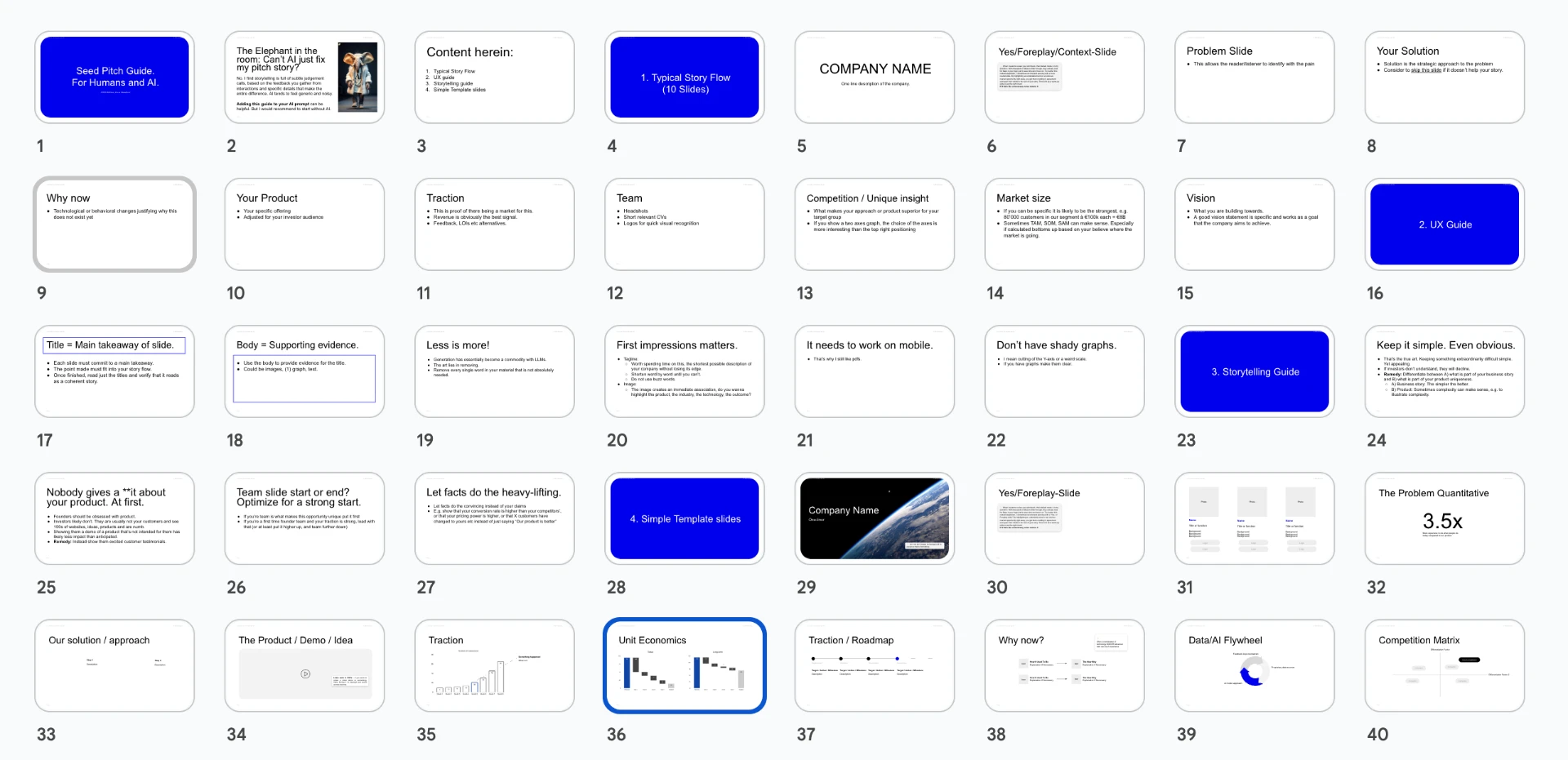
While fundraising is an art, crafting an effective pitch deck is closer to engineering.
My previous pitch deck guides, v1-v4, have been viewed over 100,000 times. Of course, there is no single format to rule them all. Yet, like in Hollywood, some story structures simply work better than others.
Three principles (3S) underpin almost everything in this guide: 1) Storytelling. Make the reader want to know what comes next. 2) Simplicity. Make the argument easy to understand. 3) Shortness. Remove everything that does not help the story.
AI has become a powerful tool for creation, but building an effective pitch deck is still difficult. AI can generate, reorganize and sharpen a story. The hardest judgment remains deciding which story is actually true, and worth telling. This guide is my latest version, updated for the age of AI.
Why bother? Does a deck matter at all?
Internal sharing. You might only speak to one person at first, but they likely represent a larger organization and will discuss your company with peers and advisors. The deck will get shared. Assumptions will be made. A bad deck can kill the opportunity behind the curtain without you ever realizing. Let's avoid that.
1. Typical story flow
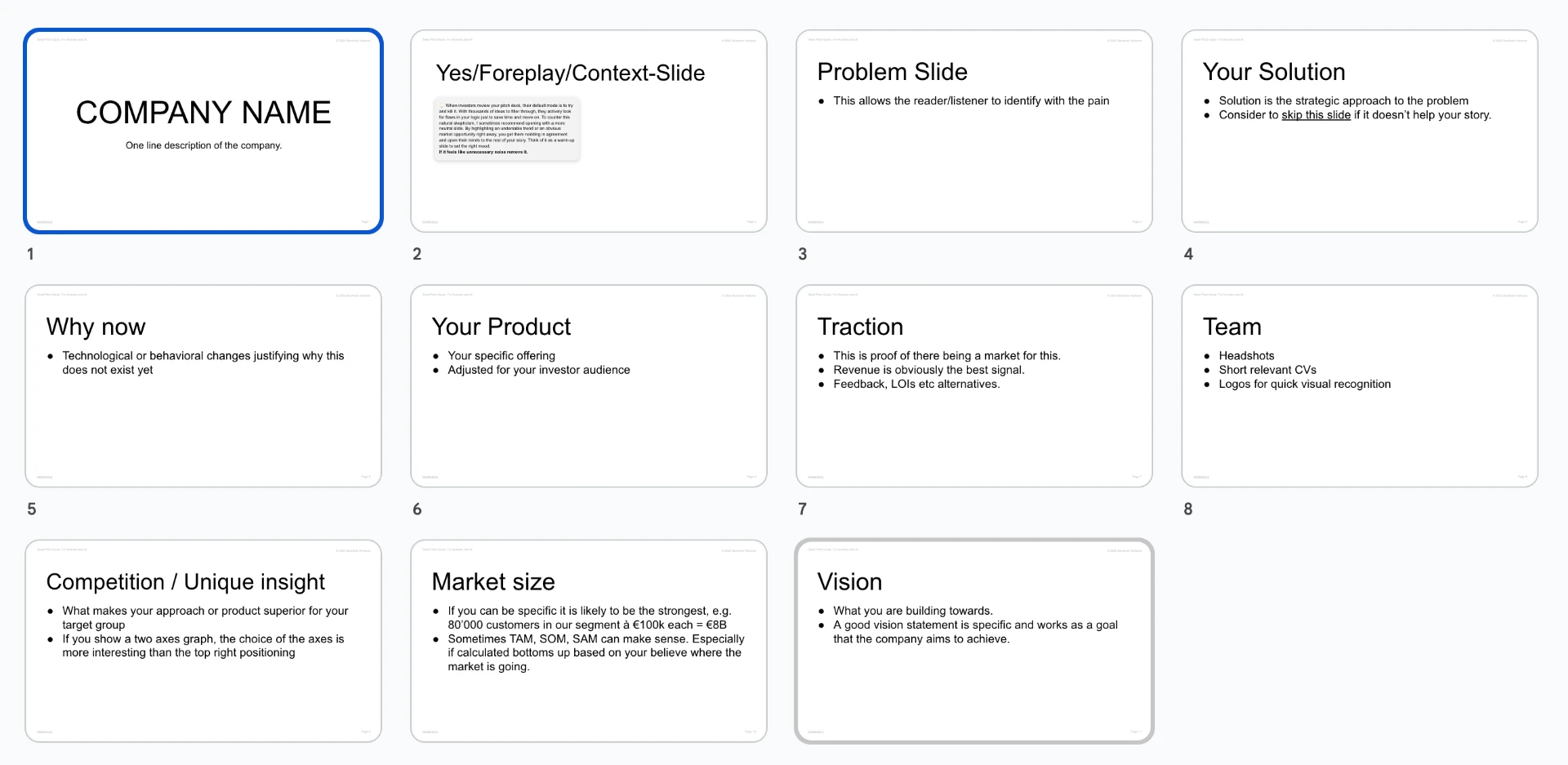
Ten core slides, plus one optional context slide. Remove it if it adds noise.
#
Slide
Purpose
1
Cover
Company name and the shortest compelling one-line description of what it does.
2
Context / "yes" slide (optional)
Start with an undeniable trend, change or opportunity that gets the investor agreeing before you present your conviction.
3
Problem
Describe the pain clearly enough that the audience can recognize and identify with it.
4
Solution / approach
Explain the strategic approach to solving the problem, not merely the product features. Skip it if it does not improve the story.
5
Why now?
The technological or behavioral changes that make the company possible or necessary now.
6
Product
Show the specific offering at the right technical depth for the investor audience.
7
Traction
Prove that a market exists. Revenue is strongest; feedback, testimonials, LOIs and other validation can substitute.
8
Team
Headshots, short relevant bios, roles, and recognizable company or institution logos.
9
Competition / unique insight
Why the approach is superior for the chosen target group, and what you understand that others do not.
10
Market / GTM
Show both how large this can become and where you start. I usually prefer a bottom-up calculation over a generic TAM statistic.
11
Vision
State specifically what the company is building toward. The vision should work as an actual goal.
2. UX guide
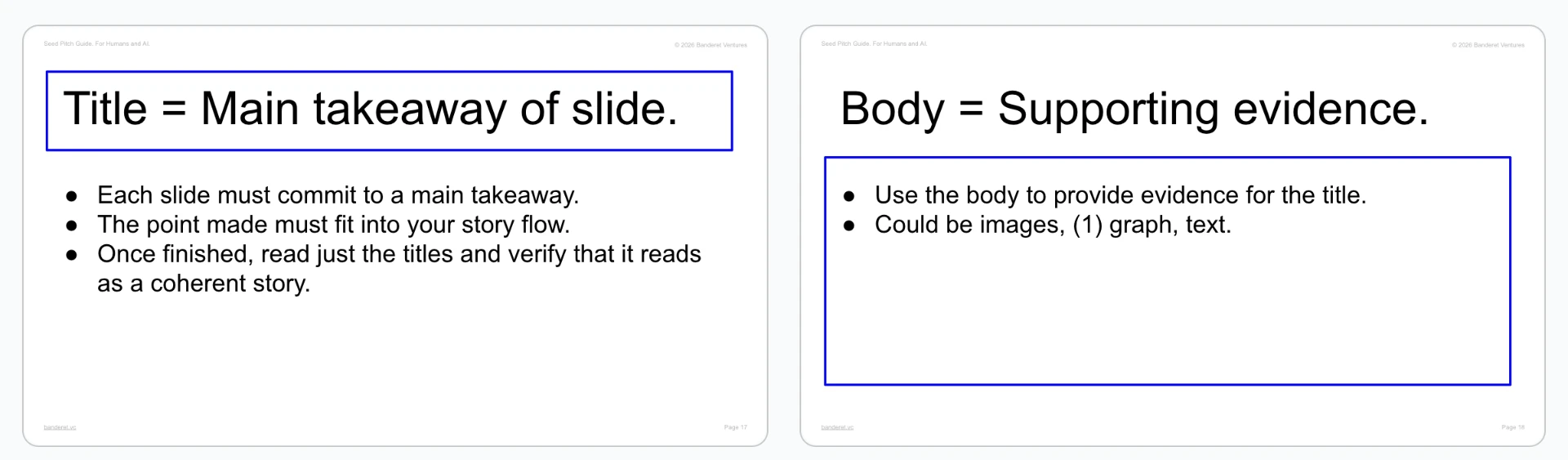
2.1 Make every slide communicate one conclusion
The title of a slide should be its main takeaway - not merely its topic.
- Instead of: Traction
- Prefer: Transactions grew 6× in eight months
The body exists to prove the title. Supporting evidence may include:
- One graph
- A quantitative fact
- An image
- Brief explanatory text
- A testimonial or other market signal
Once the deck is finished, read only the slide titles. They should form a coherent story by themselves.
2.2 Every word counts. Remove aggressively.
Generating more material is easy, especially with LLMs. The difficult and valuable work is deciding what to remove. Delete every word that is not absolutely necessary.
2.3 First impressions matter: tagline and image
The tagline is the shortest possible description of the company that retains its distinctiveness.
- Shorten it word by word until further shortening would remove something essential.
- Avoid buzzwords.
- Preserve the company's edge rather than settling for a generic category description.
The cover image also creates an immediate association. Choose deliberately whether that association should be with the product, the customer or industry, the underlying technology, or the desired outcome.
2.4 Design for mobile
- Use large, legible text.
- Avoid dense slides.
- Do not depend on a live presentation to explain the content.
- Prefer a portable format such as PDF.
- If sharing a product video, link to it from the PDF so it works across devices.
2.5 Use graphs honestly and clearly
- Do not truncate the Y-axis deceptively.
- Do not use strange scales that exaggerate results.
- Make the meaning immediately clear.
- Annotate the important event or conclusion.
- Prefer one comprehensible graph to several weak ones.
3. Storytelling guide
3.1 Use AI as a sparring partner, not the source of truth
AI can propose structures, challenge assumptions, shorten copy and generate alternative framings. But the strongest story usually comes from company-specific truths: customer conversations, founder insight, market changes and what has actually happened in the real world. Use AI to challenge and sharpen that story, not to invent it.
3.2 Keep it simple - even obvious!
- Business story: make it as simple as possible.
- Product: preserve complexity only when it helps explain the product or show why it is hard to replicate.
If investors cannot understand the opportunity quickly, they are likely to decline it.
3.3 Team slide at beginning or end?
- If the team uniquely enables the opportunity, move the team slide toward the beginning.
- If traction is stronger than the founders' track records, lead with traction and place the team later.
- Remove any optional slide that delays the story or adds noise.
3.4 Remember: investors are not your users
Founders should be obsessed with the product. Investors usually are not the customer and see hundreds of ideas, websites and demos. A product demo that was not designed for them may have less impact than expected. Customer enthusiasm can be more persuasive - consider testimonials or a concise linked video.
3.5 Let facts do the heavy lifting
Use evidence instead of adjectives. Rather than saying "our product is better", show that:
- Conversion is higher than competitors'.
- Customers switched from an incumbent.
- Pricing power is stronger.
- Costs are materially lower.
- Usage or revenue is growing.
- Customers are unusually enthusiastic.
4. Simple template slides
You can certainly find fancier slide templates. But as AI makes content abundant, judgment and simplicity become more valuable. These slides are deliberately clean.